
What role do robots play in logistics?
The key takeaways: Adopting autonomous mobile robots (AMRs) transforms logistics productivity by removing the constraints of fixed infrastructure. These flexible solutions automate transport and "goods-to-person" picking, reducing your labor costs by up to 70 %. This massive efficiency gain secures your workflows while benefiting your teams.
Discover Korben robots
Are your teams saturated under the explosion of e-commerce and ever shorter delivery times? This guide details how logistics robotics is transforming your warehouses into high-performance centers, from automated receiving to precision picking with articulated arms. Discover how the alliance between artificial intelligence and autonomous mobile robots guarantees real-time inventory management while protecting the health of your employees.
Table of Contents
The Impact of Mobile Robots and Automated Picking
After setting the stage for the necessary evolution of warehouses, let's get to the heart of the matter: self-moving machines.
Autonomous Mobile Robot (AMR) Load Transport
Unlike old AGVs, modern AMRs do not require any rails or magnetic strips on the floor. These intelligent robots map their surroundings autonomously. This gives them more freedom.
Thanks to natural navigation, the robot detects an obstacle and instantly recalculates its route. This fluid flow ensures the safety of your teams on a daily basis. It transports pallets or bins without any human intervention.
These systems offer complete flexibility. You modify your warehouse layout with a single click. The robot adapts immediately without costly infrastructure work.
AMRs don't just follow a path; they understand their environment to optimize every meter traveled.
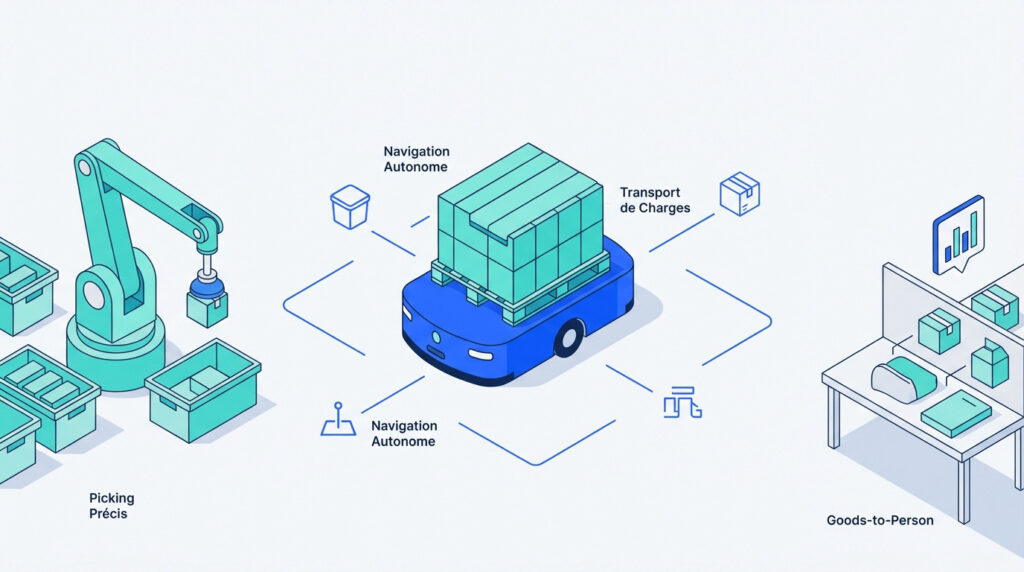
Automation of picking for smooth order fulfillment
Visit collaborative arms are based on suction pads or Smart pliers to handle your products with a stable grip, designed for operation. They manage various objects while maintaining a consistent accuracy on repetitive actions, in order to ensure the quality of preparation. The concept goods-to-person transforms the picking station. Your pickers no longer have to cross aisles. Visit bacs and storage modules arrive directly to them thanks to Autonomous mobile robots, which reduces travel and makes the pace more consistent. You gain useful time, limit errors on complex orders, and your workflows become more readable for management.
- Support Plastic bins and standard cartons.
- Charge until 30 kilograms on collaborative arms, depending on configuration.
- Vision : 3D cameras for product recognition and positioning assistance.
Software intelligence and real-time inventory management
Hardware is nothing without a digital brain to orchestrate this mechanical ballet.
WMS and WES Fleet Management
The WMS issues work orders. The software distributes tasks among available robots. Everything is centralized to avoid bottlenecks in the aisles.
Flow synchronization becomes total. Robots communicate with each other in real time. If a zone is saturated, the system diverts machines to other priorities.
Your company is gaining visibility. The manager sees the progress of orders on their screen. This is precision management that replaces the vague estimates of the past.
AI and automated inventories for seamless traceability
AI predicts storage needs. It analyzes turnover to place products in the best location. This saves space and time.
Adopt scanner robots for your aisles. They circulate at night to check inventory. They read RFID tags without error, eliminating human error.
No more unexpected stock-outs. You know exactly what's left. Replenishment orders for your Korben logistics robot are triggered automatically.
Discover the Korben logistics robot
Your logistics manager for rent starting at €499/month.

Increased productivity and valuing human work
Contrary to popular belief, this technology does not replace humans; it frees them from thankless chores.
Synergy between operators and machines to reduce strenuous work
Collaboration is key. The robot carries the heavy load, the human provides the judgment. It's a winning duo for your warehouse's overall efficiency.
Focus on occupational health. Fewer kilometers walked and less heavy lifting. Musculoskeletal disorders (MSDs) are falling dramatically in your teams.
Evolution of positions. Preparers become fleet pilots. They focus on quality control and the management of complex exceptions on a daily basis.
Security of flows and surgical precision of movements
Laser sensors ensure safety. A robot stops dead if a human crosses its path. This is much safer than a conventional forklift in motion.
Reduced breakage. Movements are smooth and controlled. Fragile products no longer suffer shocks when being handled or transported internally.
Customer satisfaction. Fewer shipping errors mean fewer returns. Service rates climb and your company's brand image is mechanically strengthened by accuracy.
Profitability and flexibility of logistics infrastructures
One major question remains: is the investment really worth it in the long term?
Comparison of gains between mobile solutions and fixed systems
Fixed conveyors are rigid. Once installed, nothing can be moved. Mobile robots, on the other hand, can be redeployed in just a few minutes.
Installation without renovation. No need to drill the slab or run cables. An old building can be automated without stopping production.
Managing peak activity. We rent additional robots for Christmas or sales. This is elastic logistics that finally adapts to the market.
| Criteria | Fixed Systems (Conveyors) | Autonomous Mobile Robots (AMRs) |
|---|---|---|
| Installation cost | Elevated (heavy work) | Moderate (rapid deployment) |
| Flexibility | Weak (static) | Total (reconfiguration) |
| Maintenance | Complex (line break) | Simplified (predictive) |
| Scalability | Difficult and costly | Easy (adding units) |
| Footprint | Permanent and cumbersome | Optimized and dynamic |
Preventive maintenance and the long-term viability of your investment
Maintenance is predictive. The robot itself signals wheel or battery wear. We intervene before a breakdown to avoid a complete stop.
ROI Analysis. Productivity gains often pay for the purchase in less than two years. This is a simple calculation based on the reduction of errors and labor costs. Logistics robotics thus becomes an immediate profitability lever for your flows.
Software updates. Your robot improves over time. New software features boost its performance without changing the hardware. Solutions like the Delivery Carry Bot – Korben For People perfectly illustrate this technical agility.
Adopting logistics robotics boosts your productivity, secures your workflows, and enhances your teams by eliminating strenuous tasks. Integrate flexible AMRs now to transform your warehouse into an agile, high-performance hub. The future of your profitability is being decided today: automate to outperform your competitors.
Try us out for free!
Try out the Korben robots adapted to your needs for a few days.
FAQ
The main missions of robots in a logistics warehouse are:
* **Inventory management:** Robots can perform tasks such as counting, locating, and tracking inventory.
* **Order picking:** Robots can help human workers pick items from shelves, increasing speed and accuracy.
* **Sorting and routing:** Robots can sort incoming goods and route them to their designated storage locations.
* **Loading and unloading:** Robots can automate the process of loading and unloading trucks, reducing manual labor.
* **Goods transportation:** Autonomous mobile robots (AMRs) can transport goods between different areas of the warehouse.
* **Palletizing and de-palletizing:** Robots can stack and unstack goods, preparing them for storage or shipment.
* **Quality control:** Some robots are equipped with sensors to inspect goods for damage or defects.
* **Data collection and analysis:** Robots can collect data on various warehouse operations, which can then be used for performance analysis and optimization.
Robots play a versatile role in energizing your supply chain. They are involved from the moment goods are received for unloading pallets, ensure optimized storage via automated storage and retrieval systems (AS/RS), and facilitate internal transport thanks to autonomous mobile robots (AMRs). Their mission is to streamline every step, from stock entry to final shipment.
By taking over repetitive and time-consuming tasks, these technological solutions enable your staff to concentrate on higher value-added missions. The aim is twofold: to respond to the explosion in e-commerce and to guarantee ever shorter delivery times to your customers.
What is the difference between an AGV and an AMR?
The major distinction lies in navigation intelligence and installation flexibility. An AGV (Automated Guided Vehicle) follows a rigid path, guided by magnetic strips or wires on the floor, and stops abruptly in front of any obstacle. Its deployment often requires costly modifications to your existing infrastructure.
Conversely, AMR (Autonomous Mobile Robot) uses laser sensors (LiDAR) and cameras to map its environment. It navigates autonomously, bypasses obstacles in real-time, and instantly adapts to changes in your warehouse layout without any ground work. This is the ideal solution for agile and scalable logistics.
How does the "Goods-to-Person" method improve order picking?
The «Goods-to-Person» (GTP) concept is revolutionizing order picking by bringing products directly to the operator. Instead of walking miles down aisles, your pickers remain at their stations while mobile robots deliver the necessary shelves or bins to them. This approach drastically reduces physical fatigue and the risk of musculoskeletal disorders.
This automation radically boosts your productivity, sometimes doubling the preparation rate. It also ensures infallible inventory reliability by eliminating human picking errors, thus guaranteeing optimal customer satisfaction even during seasonal peak periods.
What is the role of WMS and WES software in controlling robots?
This software is the brain of your installation. The WMS (Warehouse Management System) defines strategic priorities and manages your stock levels. The WES (Warehouse Execution System) acts as a real-time conductor, synchronizing WMS orders with machine capacities to avoid bottlenecks and optimize workflows.
Thanks to this software intelligence, you gain complete visibility over your operations. The system intelligently distributes tasks between humans and robot fleets, ensuring perfect coordination and immediate responsiveness to unforeseen production events.
Is robotic automation a profitable investment for an SME?
Absolutely, because modern robotics offers a fast return on investment, often seen in less than two years. Unlike heavy fixed systems like conveyors, mobile robots require little initial infrastructure investment and can be deployed gradually. This allows you to adjust the size of your fleet according to your business growth.
Beyond pure productivity gains, the investment is sustained by predictive maintenance and regular software updates. Your robots become more performant over time, reducing operational costs associated with breakdowns, shipping errors, and the strain of manual labor.
Make an appointment with our expert
Do you need more information?Would you like to test our robots free of charge?Leave us your contact details and Sylvain, our expert, will call you back within 24 hours.

Sylvain Ballario
Business Development Director

