- Autonomous robots
- Intuitive interface
- Compliance with CE standards
- French customer service
- Autonomous robots
- Intuitive interface
- Compliance with CE standards
- French customer service
- Autonomous robots
- Intuitive interface
- Compliance with CE standards
- French customer service
- Autonomous robots
- Intuitive interface
- Compliance with CE standards
- French customer service
- Autonomous robots
- Intuitive interface
- Compliance with CE standards
- French customer service
- Autonomous robots
- Intuitive interface
- Compliance with CE standards
- French customer service
- Autonomous robots
- Intuitive interface
- Compliance with CE standards
- French customer service
- Autonomous robots
- Intuitive interface
- Compliance with CE standards
- French customer service
Understanding a cleaning company's price list avoids discrepancies between the advertised price and the total price paid on the monthly invoice.
In France, a cleaning company calculates its services according to the surface area to be cleaned, the type of service, the duration of the service and the geographical location.
The expected level of cleanliness also counts, especially in offices, medical facilities or after building work, where a thorough cleaning may be necessary.
For a reliable estimate, compare an average hourly rate with a rate per square metre, then ask for a detailed, item-by-item cleaning quote.
And when your floors account for the lion's share of the work, automating these passages can reduce the amount without sacrificing regularity, with the Korben cleaning robot.

Table of Contents
What is the average cost of a cleaning company?
The market offers several pricing methods.
Some companies charge by the hour, others by the square meter, and a few construct a monthly package.
The most important thing is the exact scope, because a “cheap” quote sometimes overlooks items.
In shared spaces, cleaning the common areas often weighs heavily on the budget, as there are frequent visits.
Average hourly rate for a cleaning company
The usual range is between €20 and €40 excl. tax/hour, depending on the region and constraints.
This price often includes equipment, consumables, supervision and travel.
An independent cleaner may charge less, but the service doesn't always offer the same structure.
An organized company provides planning, control and continuity in the event of absence.
The hourly rate also varies according to the work involved:
- The level of dirt and the need for disinfection.
- Site access, work schedule and safety constraints.
- The type of floor, such as carpet, tile, vinyl or concrete.
In a building with a constant flow of people, professional service often increases the duration, as the areas quickly become dirty again.
Lobbies, corridors and elevators also need to be treated as contact points.
Office cleaning rates per m²
For offices, price per m² averages between 1 € and 5 € / m², depending on the perimeter.
This mode of calculation helps when the surface is stable and the tasks well defined.
Frequency makes all the difference, because a daily run costs more than a weekly one.
A open space also requires regular dusting and attention to sanitary areas.
Simple examples, to be adjusted according to service and frequency:
- 200 m² at €2/m², the budget approaches 400 € per pass.
- 500 m² At €1.6/m², the amount reaches 800 € per pass.
- 1 000 m² at €1.2/m², the total rises to 1 200 € per pass.
When the site includes common areas, the cleaning common areas is added to the office perimeter.
This applies to lobbies, corridors, parking lots or shared reception areas.
For quick comparison, a useful benchmark is our internal resource: cleaning company rates.
What is the average monthly cost for a small business?
The monthly cost depends on the number of passages, sanitary facilities and glass surfaces.
Very small businesses often aim for a simple contract, with regular services and visual checks.
SMEs sometimes add a stricter level of hygiene to sensitive areas.
The budget must take into account periods of high activity and occasional needs.
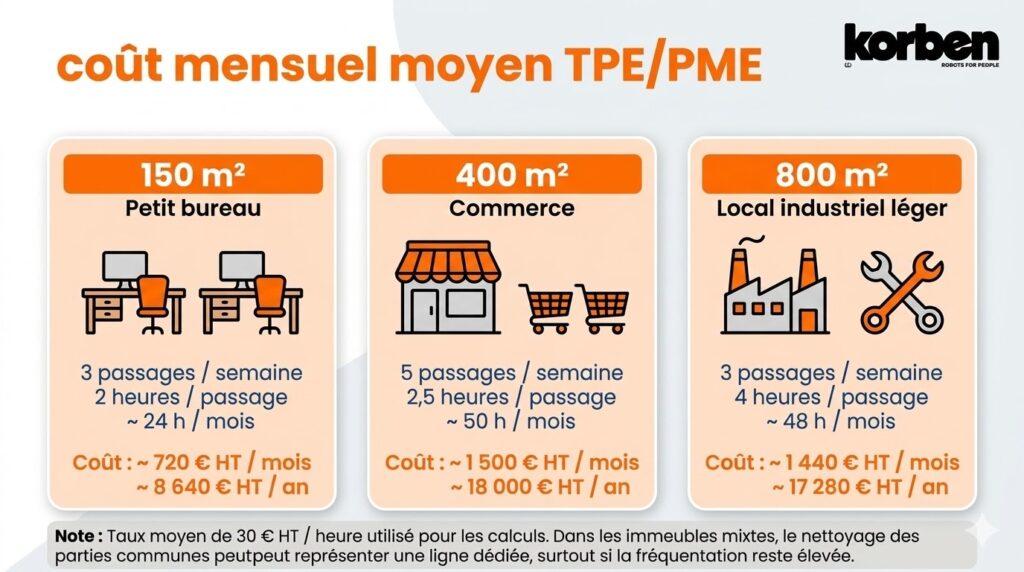
Typical simulation, for information only, excluding options :
- Small office 150 m² 3 passages per week, 2 hours, i.e. approximately 24 h / month.
- Trade 400 m² 5 passages per week, 2.5 hours, i.e. approximately 50 h / month.
- Light industrial premises 800 m² 3 passages per week, 4 hours, i.e. approximately 48 h / month.
Assuming an average rate of 30 € HT / hour, gives :
- 150 m² : approx. 720 € HT / month, then 8,640 excl. tax / year.
- 400 m² : approx. 1,500 excl. tax / month, then 18,000 excl. tax / year.
- 800 m² : approx. 1 440 € HT / month, then 17,280 excl. tax / year.
In mixed-use buildings, the cleaning common areas can represent a dedicated line, especially if traffic remains high.
A well-defined contract also avoids costly catch-ups.
What factors influence the cost of professional cleaning?
A reliable quotation is based on measurable parameters.
The clearer the scope, the more comparable the proposal between service providers.
The best way to do this is to list the zones, the frequency and the expected quality criteria.
The cleaning common areas must appear explicitly if the site includes shared spaces.
Surface area of premises to be cleaned
The larger the surface area, the lower the price per m².
This mechanism is due to the volume effect, as preparation times are diluted.
A large tray also makes for more efficient routes, with fewer trips.
However, nooks and crannies, staircases and multiple levels break this logic.
Type of premises
Prices vary according to the nature of the site and usage constraints:
- Offices dusting, sanitary facilities, glazing, waste garbage can management.
- Commerces / retail : early passages, glazed areas, more visible floor marks.
- Shared spaces lobbies, corridors, parking lots, high-volume flows.
- Light industrial premises : specific dusts, robust coatings, safety instructions.
In one building, the cleaning common areas often requires more detailed organization.
Time slots, access and waste management change rapidly over time.
Intervention frequency
Frequency drives the budget, as it determines the monthly time.
Three rhythms dominate the contracts:
- Daily useful on busy sites or those with sensitive sanitary facilities.
- 2 to 3 times a week Current balance for offices and shops.
- Weekly Suitable for small premises, provided usage remains moderate.
A well-adjusted frequency stabilizes cleanliness and protects your image with customers.
It also reduces clogging, and hence the additional costs associated with overhauls.
In residences and multi-use sites, the cleaning common areas needs to be planned with regular checkpoints.
Services included
A cleaning service is defined first and foremost by its scope.
Without a precise list, the quotation becomes blurred and quality varies according to the team.
On mixed sites, the cleaning of common areas is often added to the cleaning of business premises.
A contract generally includes :
- Routine maintenance: washing floors, wiping workstations, managing waste garbage cans, checking cleanliness.
- Sanitary facilities: restocking, descaling, reinforced hygiene, disinfection of contact points.
- Glazing: cleaning of accessible windows, display cabinets, doors, glass partitions.
- Technical cleaning: specific areas, carpets, stripping, restoration after work.
Cleaning common areas often requires targeted action.
Handles, elevators, corridors and lobbies impose strict routines, because use is shared.
A useful reference point is a cleaning company's price list.
Operating hours
Timetables directly affect prices and organization.
Switching to working hours sometimes hinders activity, but reduces constraints.
Evenings and nights limit the impact on teams, while adding to the complexity of access.
Three cases are common:
- Working hours: easy access, but more interruptions and risks of untreated areas.
- Evening/night: more regular results, as the rooms are free.
- Possible surcharges: depending on schedules, security, alarms and site constraints.
In a building, the cleaning of common areas is often a matter of course.
This choice avoids crossing paths with residents and limits slipping on wet floors.
What does the advertised cost of a cleaning service really include?
A rate never corresponds to a single hour spent cleaning.
The actual cost adds up the charges, supervision and obligations linked to the service.
This is also what differentiates a structured company from a more informal solution.
In most cases, the price includes :
- Labor: on-site time, internal travel, set-up.
- Social charges: employer costs, replacements, administrative management.
- Equipment and products: vacuum cleaner, mops, consumables, detergents adapted to floor type.
- Supervision: control, planning, contingency management.
- Insurance: liability, material damage, operations in sensitive areas.
On a site with cleaning of common areas, insurance and control are more important.
High-traffic areas are more prone to complaints and damage.
Why can the quote differ from the advertised price?
A “from” price is mainly used as a quick estimate.
Customized quotations vary as soon as real constraints are taken into account.
A simple audit will often reveal invisible positions in an advertisement.
Differences generally come from :
- Additional services: more frequent glazing, reinforced sanitary facilities, waste management.
- Site features: staircases, limited access, badges, alarm, multi-floor zones.
- Post-audit adjustments: change of frequency, addition of a disinfection protocol.
The cleaning of common areas is a good example of this.
A glazed hall or parking lot quickly adds to your time and therefore your monthly budget.
Independent contractor or cleaning company: what's the best choice?
The right choice depends on the level of requirement, the need for continuity and the risk accepted.
A medical site, a retail outlet or an open space do not have the same tolerance for irregularity.
The cleaning common areas also requires stable organization, as the passages are visible.
Would you like a precise estimate for the maintenance and/or cleaning of your premises? Contact our experts. They'll be delighted to answer any questions you may have about our cleaning robots.
Advantages and limitations of an independent service provider
An independent can offer a price list and a direct relationship.
This option works best on a small, simple and unconstrained perimeter.
Key points:
- Price sometimes inferior, with a light structure.
- Risk of absence higher, so holes in the schedule.
- Less continuity if replacement difficult or equipment limited.
Advantages and limitations of a structured company
A company provides a framework, processes and replacement capacity.
It also makes quality control easier to monitor.
Key points:
- Stability and organized team rotation.
- Framing with supervision and reporting.
- Cost higher, linked to expenses and piloting.
Why will cleaning costs rise in 2026?
Budgets are increasing for structural reasons, not just commercial ones.
Wage increases, recruitment difficulties and staff turnover are weighing on schedules.
Employer charges and obligations are also changing, and this has repercussions on contracts.
Common factors :
- increase in the minimum wage and associated costs.
- recruitment pressures and replacement needs.
- high turnover, so recurrent training.
- increase in expenses and the cost of consumables.
When cleaning costs rise, the best response is to optimize the perimeter, not cut back on hygiene.
- Take back control of the service by separating high-traffic areas from secondary spaces, then align the frequency of intervention with actual usage.
- Adjust the contract, clarify tasks, and remove low-value passages, especially on large floors in offices or premises.
- With a customized quote based on the area to be cleaned, the time charged and the sanitary facilities, you stabilize your budget and limit the cost of cleaning over the year.
Or, to be honest, for more optimal costs, don't hesitate to opt for a professional cleaning robot => guaranteed savings for professional cleaning quality!
How can you optimize the cost of cleaning your premises?
Optimizing doesn't mean degrading cleanliness.
The aim is to distribute effort more evenly and eliminate unnecessary repetitive tasks.
On large stages and corridors, this is often where the budget comes into play.
Intelligent frequency adjustment
Frequency should follow usage, not habit.
High-traffic areas require more regular traffic than secondary rooms.
Examples of efficient logic :
- reception, sanitary facilities, open space: reinforced rhythm.
- little-used rooms, reserves: lighter pace.
- corridors and lobbies: regular maintenance, as this is where the image is at stake.
Adapting specifications
A well-written specification reduces the risk of drift and “oversights” billed later.
It enables zone-by-zone cleaning based on simple, measurable criteria.
Two concrete levers:
- Differentiated cleaning Intensive on washrooms, targeted on windows, light on little-used areas.
- Optimization of repetitive tasks automate large linear surfaces, and keep the human touch on the details.
Automate time-consuming tasks
The simplest optimization consists in targeting those things that consume time without greatly improving the result.
For many sites, the heaviest workload remains the cleaning of large floor areas.
These routes are repeated every day, with the same gestures and the same constraints.
When automating a part of the perimeter, three gains are often mentioned:
- Cleaning large floor areas corridors, halls, reception areas, long aisles.
- Repetitive tasks with low added value : identical passages, touch-ups related to daily traces.
- Continuity without HR dependency less impact in the event of absence, less disruption to planning.
Humans take care of the finishing touches, complex areas and one-off interventions.
Robotics, on the other hand, takes linear, predictable areas, where regularity makes the difference.
This division improves perceived quality, while stabilizing the budget.
Cleaning robot vs. traditional company: how profitable is it?
Profitability is calculated over time, not over a single month.
A standard contract depends on the volume of hours, replacements and scope adjustments.
A robotized solution should be seen as an investment, with its own management and organization.
In both cases, the result is based on clear specifications and simple controls.
3-year cost comparison
To compare, start with a realistic, stable scenario.
Note the surface area concerned, the frequency, and the current time spent on these areas.
Then distinguish between what can be standardized and what must remain manual.
Over 3 years, a “classic company” approach often adds up :
- hours of regular service, over 36 months.
- occasional overhauls, depending on soiling.
- tariff increases, linked to costs and the market.
A “robotized” approach is more like this:
- set-up costs and course configuration.
- scheduled maintenance and consumables, depending on usage.
- remaining man-hours, for finishing touches and specific points.
The aim is not to automate everything.
The aim is to reduce the most mechanical hours, then secure quality.
Return on investment
ROI is seen when loads become more predictable.
Robotics helps in three main ways:
- Stabilizing expenses fewer variations linked to repeated hours.
- Reducing turnover less pressure on schedules and continuity.
- Amortization Once the rhythm is in place, the marginal cost per passage drops.
ROI becomes clearer when the site has large corridors and open plateaus.
It becomes slower on small, highly fragmented surfaces.
For which types of premises is robotics the most cost-effective?
Robotics become interesting when the surface area is large and the frequency high.
It works equally well in places where quality must remain constant.
The most favorable contexts :
- Superstores with linear paths.
- Stores with entrance, aisle and reception areas.
- Light warehouses with even floors and plannable traffic flow.
- Open offices and open spaces, with long, uncluttered zones.
In these cases, a hybrid model often provides the best balance.
Robot for floors, human for details, glazing and sanitaryware.
- TO THE HOUSEHOLD
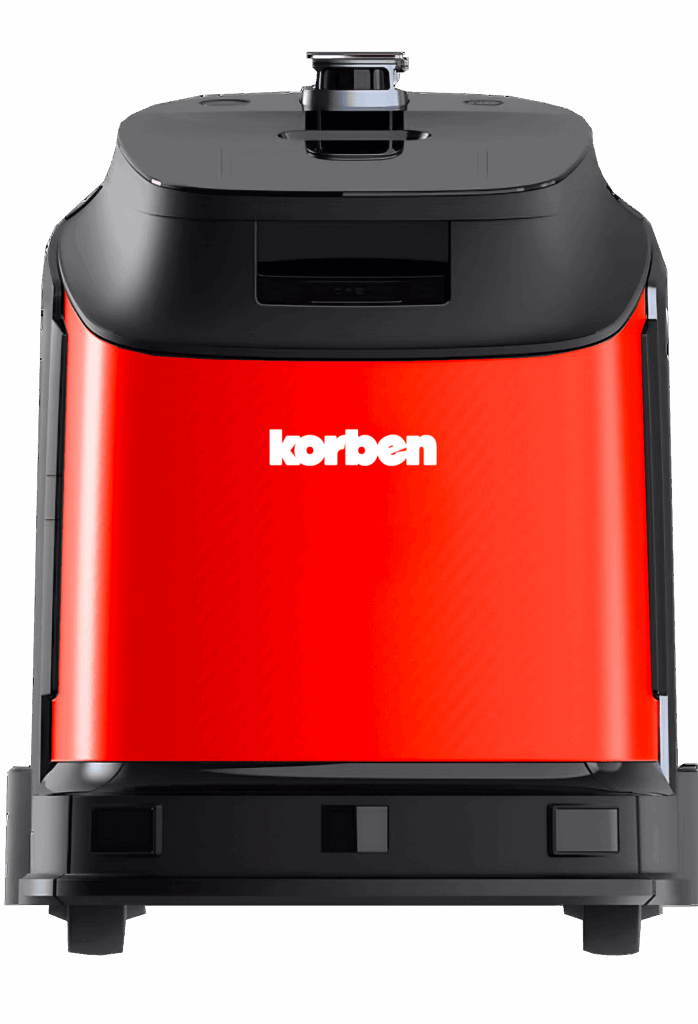
Korben Phantas 50
All-in-One Auto-scrub Floor Cleaning Solution
Phantas is the intelligent robot that manages autonomously maintenance of your surfaces. Equipped with cutting-edge technologies such as LiDAR, depth cameras and sophisticated sensors, Phantas 50 moves with agility and precision, even in complex environments.
- Totally autonomous
- Cleaning up to 1000 m2 per load
- High-performance 360° scrubber-dryer
How can you get a customized quote for your premises?
A good quotation starts with an audit, even a quick one.
Without a visit, the service provider often underestimates access constraints and sensitive points.
To get a useful estimate, prepare :
- Surface audit m², floors, areas to be treated, coatings.
- Actual frequency required Daily, bi-weekly, weekly, depending on usage.
- Traffic analysis : peak hours, critical areas, seasonality.
- Robotic demonstration request Test your most expensive routes.
This method allows you to compare offers on an identical basis.
It also avoids “surprise” options added after start-up.
Conclusion: to keep your costs under control in 2026, focus on useful frequency, measurable specifications, and automation of the most time-consuming floor areas.
Try us out for free!
Try out the Korben robots adapted to your needs for a few days.
FAQ Cleaning company rates
What is the average cost of office cleaning in 2026?
We often observe 20 to 40 € HT / hour depending on region and constraints.
On a m² basis, many contracts are around 1 to 5 € / m² depending on frequency.
The final cost depends mainly on sanitary fittings, glazing and opening hours.
Is the m² rate better than the hourly rate?
The m² makes reading easier when the perimeter is stable and well described.
The schedule remains more precise when the site changes, with variable tasks.
The best choice depends on the level of control and quality required.
Does the advertised price always correspond to the final quote?
No, because the price displayed does not know your site.
The quotation includes access, constraints, hygiene levels and options.
An audit greatly reduces the gap between estimate and invoice.
Which solution is more cost-effective in the long term?
A hybrid approach is often the most balanced.
You automate the routes on the ground, then keep the human touch on sensitive areas.
This combination stabilizes quality and limits dependence on recruitment.
How much does deep cleaning cost?
Deep cleaning is more expensive than regular maintenance, as it involves a major and sometimes even a complete cleaning.
Prices and rates vary according to surface area, level of dirt, type of floor and rooms to be treated.
For a house cleaning, the average price also depends on sanitary facilities, windows and difficult areas.
When specialized cleaning is required, a personalized estimate is the only reliable basis for calculating the cost of the service.
Make an appointment with our expert
Do you need more information?Would you like to test our robots free of charge?Leave us your contact details and Sylvain, our expert, will call you back within 24 hours.

Sylvain Ballario
Business Development Director
