- Autonomous robots
- Intuitive interface
- Compliance with CE standards
- French customer service
- Autonomous robots
- Intuitive interface
- Compliance with CE standards
- French customer service
- Autonomous robots
- Intuitive interface
- Compliance with CE standards
- French customer service
- Autonomous robots
- Intuitive interface
- Compliance with CE standards
- French customer service
- Autonomous robots
- Intuitive interface
- Compliance with CE standards
- French customer service
- Autonomous robots
- Intuitive interface
- Compliance with CE standards
- French customer service
- Autonomous robots
- Intuitive interface
- Compliance with CE standards
- French customer service
- Autonomous robots
- Intuitive interface
- Compliance with CE standards
- French customer service
Cleaning common areas: roles and laws to know
In a condominium building, the cleanliness of common areas has a major impact on the safety, welcome and quality of life of residents.
It covers tasks such as washing floors, cleaning lobbies, windows, door handles, disinfecting sensitive areas and waste management.
In terms of organization, the managing agent oversees management, selects a service provider or specialist company, monitors the service provided, and presents the condominium budget to the general meeting.
We'll help you clarify everyone's role, the person responsible for cleaning, the frequency of cleaning, and the co-ownership charges distributed according to the tantièmes, within a legal framework derived from the July 1965 law establishing the status of co-ownership.Finally, if your need is for a more regular and traceable solution, automation can complement the human touch.

Table of Contents
What are common areas in a condominium?
In condominiums, common areas include areas and equipment intended for use by all. The cleaning of common areas therefore concerns a wide variety of surfaces, with different levels of hygiene depending on flows and risks.
Legal definition of common areas
The law of July 1965 describes the parts of the building assigned to the collective use of co-owners.
In practice, we often find spaces such as :
Stairs and banisters
Entrance halls and lobby
Corridor and landings
Elevator and controls
Parking and exit areas
Garbage garbage cans and collection points
Shared outdoor spaces, walkways, accesses
Each area requires its own specific service. Washing too infrequently will damage floors, glass and handles, especially in wet weather.
How can I find out which parts of my building are common?
The most reliable is the condominium by-laws, which detail what is common and what is private.
The descriptive statement of division completes this reading, specifying the organization of lots and zones.
These documents are also used to clarify private use of a shared area, such as a terrace or garden.
In case of doubt, the managing agent can provide an updated version, useful for avoiding a dispute at the general meeting.
The cleaning of common areas must always respect this documentary framework, as it influences the service provider's mission and costs.
Who is responsible for cleaning common areas?
The question often comes up when there's a change of tenant, a claim or a visible maintenance fault.
In order to make the right decision, we need to distinguish between management obligations, task performance and cleaning responsibilities.
The role of the condominium manager
The condominium manager oversees the maintenance of common areas on behalf of the condominium association.
- He organizes a clear implementation, with a maintenance contract and precise specifications.
- He selects a cleaning company or external service provider, then schedules follow-up.
- He also draws up the maintenance budget and checks the value for money.
A useful benchmark for comparing offers is to consult a cleaning company rates before requesting a cleaning estimate.
This approach helps to define costs, frequency, schedules and the products used, such as detergents and cleaners.
The cleaning of common areas can be entrusted to a professional contractor, a cleaning company or an in-house system.
In some cases, a voluntary syndic also oversees day-to-day management, with stricter limits on control.
Legal maintenance obligations
The co-ownership must keep the building in good condition, which includes regular maintenance and ensuring a safe environment.
As well as aesthetics, the issue is hygiene and traffic safety.
A slippery hallway, saturated carpeting or poorly managed garbage cans increase the risk of falls and nuisance.
An effective plan often includes :
weekly cleaning of floors and contact points
targeted disinfection of handles, elevator buttons and handrails
control of glass and windows in halls, depending on soiling
removal of bulky items, to preserve access and use
Cleaning common areas is therefore not an option, but an essential part of maintaining them in good working order.
Tenant or owner: who pays?
Payment depends on the type of expense and the line of charge
Certain routine maintenance expenses are recoverable from the tenant, according to the legal list.
In practice, the landlord makes an advance payment via the condominium corporation, then invoices the tenant according to the rental charge rules.
A general distinction is made between :
rental expenses: routine maintenance, products, minor service-related work
condominium charges: non-recoverable expenses, major repairs, restoration after structural deterioration
Cleaning common areas is often included in routine maintenance, provided the service remains “standard”.
In the case of exceptional work or restoration after damage, the breakdown may change depending on the case.
What's involved in cleaning common areas?
Good cleaning of common areas has three objectives. It keeps the environment clean, reduces risks and protects finishes. It also makes life easier for residents, as a pleasant environment reduces tensions. The building manager often relies on a maintenance contract to provide a framework for service and follow-up.
Tasks included in a classic contract
A “standard” contract specifies the expected cleaning services.
It describes each task with a frequency, an estimated time and a zone.
The most common actions cover :
Floor sweeping and washing, depending on floor type and surface.
Cleaning of entrance hall windows and glass doors.
Disinfection of elevator handles, switches and buttons.
Waste management, bag removal, garbage can room control.
Dusting of skirting boards, handrails, mailboxes, window sills.
The notebook can add “special attention” items. These might include marks on mirrors, oil stains in the parking lot, or sand on the stairs. The choice of product also counts, especially on delicate floors. A detergent that is too aggressive will wear away the surface and increase the cost of restoration.
Hygiene rules
Hygiene rules are based on logic, rather than on a single “recipe”.
Condominiums must aim for a level of cleanliness consistent with use and risks.
Three points guide our approach:
Minimum frequency depending on traffic and weather.
Sensitive areas that concentrate germs, such as handles or elevators.
Occupant safety, with non-slip floors and well-metered products.
An organization sheet helps you to follow good practice.
It specifies times, access and instructions in the event of damage.
Once this framework has been established, it's all a question of execution. The minimum frequency must match the level of traffic, otherwise dirt will settle in and touch-ups will be more expensive. Finally, quality is measured by concrete signs: streak-free floors, controlled odors, clean contact points, well-managed waste garbage cans.
How often should you clean common areas?
The right cleaning frequency depends on the amount of traffic, equipment and configuration. If common areas are cleaned too frequently, the result is rapid soiling. Conversely, over-scheduling puts a strain on the budget with no visible gain.
Standard residential buildings
In a quiet building, a weekly inspection of the floors may suffice. We often add a check of garbage cans and contact points. Hall windows tend to be treated periodically, depending on exposure. A clear routine limits complaints and stabilizes quality.
High-traffic residences
A densely-populated residence calls for more rigor, especially at peak times. Elevator buttons, handles and handrails require more frequent disinfection. Garbage disposal must follow a tight schedule to avoid odors and overflows.
Here, regularity becomes a criterion for quality of life.
Parking lots and outdoor areas
- The parking lot is subject to dust, mud, leaves and tire tracks.
- Cleaning too infrequently makes the floor slippery and damages the markings.
- Outdoor spaces need to be planned with the seasons, as needs change.
Here, regularity makes all the difference: a short but frequent pass avoids build-up, limits slipping and protects markings. As these areas represent long, repetitive surfaces, a fixed schedule becomes the best lever for stabilizing cleanliness and controlling the budget.
How much does it cost to clean common areas?
Pricing is built around a perimeter, a frequency and a level of requirement. Companies often invoice on a fixed-price basis, by the hour, or by m². In the Île-de-France region, prices can be much higher than in the rest of France.
What factors influence price?
There are a number of factors that can affect the cost estimate, even for the same surface area:
Surface and number of floors to be covered.
Frequency and expected running time.
Accessibility, elevator, narrow stairs, technical access.
Location, especially Paris versus province.
Configuration matters, because a long corridor takes time and doesn't offer “batch” cues.
Price range
- In France, we often see benchmarks of €20 to €35 per hour for a standard service.
- Some players also quote €1.20 to €2.50 per m², depending on scope and frequency.
- For a small condominium, a monthly fee could be around €150 to €400.
- For larger developments, ranges from €900 to €2,500 per month appear, depending on standing.
These figures are only indicative, as each contract has its own inclusions and exclusions.
How are costs distributed?
- Expenses are charged to general expenses and allocated according to the tantièmes.
- The regulations specify the distribution key and any exceptions.
- The managing agent presents the expense to the assembly, with a budget and follow-up.
This is an expense that quickly takes its toll, as it recurs throughout the year and leaves no margin for error. As soon as the frequency increases, or a refurbishment is added, the impact is immediately visible on the call for funds.
As a result, condominium owners have to strike a balance between cleanliness, resident comfort and budget control.
Why is traditional cleaning a problem for condominiums?
A cleaning common areas is highly dependent on people and schedules. When organization breaks down, the condominium suffers visible and costly variations.
Turnover and absenteeism
- Turnover complicates continuity, especially on multiple sites.
- A poorly prepared replacement reduces quality and creates oversights.
- Occupants soon notice the difference, as the contact areas get dirty first.
Irregular quality of services
- Two identical runs on paper sometimes produce opposite results.
- The actual time spent varies, especially when the service provider optimizes his route.
- Without precise specifications, the service drifts towards a “minimum” that degrades the living environment.
Difficulty of control and traceability
- Property managers sometimes lack simple tools to check what has been done.
- Control then relies on occupant returns, often late in the day.
- Traceability is becoming a key issue, especially after a claim.
Ongoing rise in labor costs
Prices evolve with salaries, charges and scheduling constraints.
The market also operates with variations according to zone and availability.
This pressure feeds into arbitration and budget discussions.
More rigorous management, clear definition of tasks and regular measurement of results reduce this friction, while keeping the building clean.
How to optimize maintenance of common areas?
Optimizing maintenance is not about “cleaning more”.
The aim is clearer management, shared priorities and simple control.
With a solid method, cleaning common areas becomes predictable.
You reduce friction between co-owners, tenants and landlords.
Drawing up precise specifications
Precise specifications avoid misunderstandings and ensure the security of the service.
It describes the reality of the site, not a generic list copied from another building.
To frame the execution, define :
Task definition: floors, glass, dustbin, handles, contact areas.
Frequency: weekly, twice-weekly, daily, depending on passage.
Quality indicators: floor marks, odors, dust on ramps, condition of hall.
Add useful constraints, such as hours of operation, technical access and type of cleaning products.
Also specify the limits, e.g. fragile carpet or porous floor.
In this way, the cleaning of common areas becomes more consistent.
Set up a rigorous monitoring system
Without follow-up, the contract remains a document that lies dormant in a filing cabinet.
Light steering is often all that's needed, if everyone plays along.
Set up :
Visual inspection: checklist by zone, before/after photos if required.
Reporting: monthly updates, anomalies, targeted intervention requests.
Internal audit: occasional visits by the union council or manager.
This monitoring protects the budget, as it avoids re-cleaning and disputes.
It also reinforces compliance with the rules, especially with regard to waste and parking.
The result is more reliable cleaning of common areas.
Automate repetitive and time-consuming tasks
- Automation targets tasks that are long, regular and easy to standardize.
- It complements human work, rather than putting it under strain.
- It is well suited to large linear surfaces, where labor is expensive.
Areas such as corridors, halls, parking lots and long linear surfaces account for the majority of time spent... and costs.
- TO THE HOUSEHOLD
Korben Phantas 50
All-in-One Auto-scrub Floor Cleaning Solution
Phantas is the intelligent robot that manages autonomously maintenance of your surfaces. Equipped with cutting-edge technologies such as LiDAR, depth cameras and sophisticated sensors, Phantas 50 moves with agility and precision, even in complex environments.
- Totally autonomous
- Cleaning up to 1000 m2 per load
- High-performance 360° scrubber-dryer
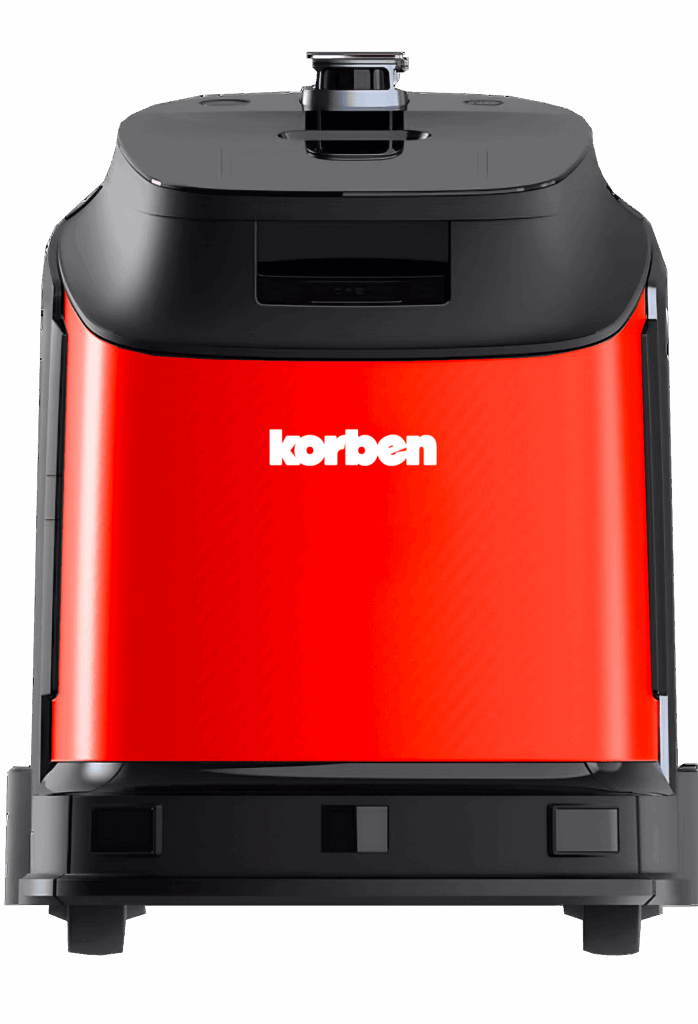
Autonomous robotics: an innovative solution for cleaning communal areas
Autonomous robots provide a concrete solution when service requirements vary too much. They can be integrated into an existing organization, with a schedule and simple rules. For condominiums, the challenge is to ensure regularity and traceability.
The cleaning of common areas then becomes a controllable service.
Why automate cleaning?
Automation is first and foremost about consistency and visibility of results.
Depending on the scenario, it provides :
Excellent cleaning quality Stable results on repetitive zones.
Customized cleaning : programs adapted to schedules and passages.
Perfect regularity : identical cadence, with adjustments and planned cycles.
No absenteeism : operation with no human scheduling contingencies.
Programmed operation : defined launches, station returns, cycles.
Passage traceability A useful history for the building manager and for auditing purposes.
This logic limits discrepancies between sites, which helps with rental management.
It also reduces tensions when an occupant deems the service “insufficient”.
In this way, cleaning common areas becomes easier to understand.
Impact on operating costs
The economic benefits come from the reduction in repetitive tasks.
You keep the human element in the fine-tuned actions, and standardize the rest.
The expected benefits often read as follows:
Fewer human hours spent on the same floor path.
More stable medium-term budget, with planned cycles.
More predictable expenses, so fewer surprises at general meetings.
The cleaning common areas benefits from better budget control.
What the Korben robot can do
Korben deploys service robotics designed for professional environments.
For maintenance, the approach aims for regular execution, without complicating the life of the site.
In concrete terms, the Korben robot enables :
Daily cleaning performance
Programmed self-cleaning
Suitable for residential buildings
Reduce repetitive tasks
Complementarity with humans (not total replacement, but optimization)
Try us out for free!
Try out the Korben robots adapted to your needs for a few days.
FAQ
What can I do if the cleaning of common areas is poorly done?
A poorly executed service is best treated with a factual and documented approach.
Photos, dates, areas concerned and impact on safety speed up resolution.
The aim is to return to an acceptable level, without unnecessary conflict.
What kinds of spaces can be automated?
Some spaces are better suited to autonomy, because they are repetitive and measurable.
These include :
Building lobbies
Corridors
Parking lots
Student residences
Social landlords
These zones combine surface area, frequency and cleanliness expectations.
They also account for a large share of traffic hours.
Make an appointment with our expert
Do you need more information?Would you like to test our robots free of charge?Leave us your contact details and Sylvain, our expert, will call you back within 24 hours.

Sylvain Ballario
Business Development Director
